Cynthia Herron
 Writing

Artist Statement
Portfolio
Painting
Writing
Fabric Art
Resume
Current Shows  & Workshops
Contact


Chapter 17 Wolverine

Chapter 17 WOLVERINE

I awoke from a dream one morning that spring and there it seemed to be: shaggy brown hair, wild eyes looking back at me, one front leg partially raised. Apprehensive. Ready to run or attack.
Wolverine? I had never seen one in real life. Never been curious about them. Hardly knew what they looked like. I was shaken. Why this image? Why now? I hurried to record it, working under the single light bulb in the studio with pencil in my sketchbook. I roughed out a 12†x 9†composition of the beast with trees, shrubs, and flowers. I turned pages in magazines and library books looking for pictures of wolverines. I bought an expensive sheet of watercolor paper, something that would endure working and reworking. I traced and enlarged, studied and erased and modified.
Did this beast mirror my fierce desire to be a successful artist? To be wild and untamed? Or the confinement I felt as a new mother? Maybe both? If so, what was holding me back?
In my vision, the wolverine is surrounded by a Victorian garden. She turns to look at me with a fierce growl, one front paw partially raised. Its other paws sink into a manicured lawn. Trimmed hedges trap her among elegant flowers, tall trees, and stone walls. Annuals bloom along ornamental brick paths. Long branches of a weeping willow partially obscure an ornate iron bench. A fountain of three dolphins spout curves of water in the distance. No other visible signs of life exist in the garden, just this one wild creature. Further up the hill, the tall wrought iron gate is latched shut.
From my research, I learned that most wolverines are solitary, even the females. They live in remote areas such as tundra of northern Canada, parts of Alaska, Siberia, Scandinavia, and the northern United States Rockies and Cascades. They prefer mountainous snowy wilderness. Not to be confused with badgers, wolverines are larger with longer hair. They are related to weasels and have a reputation for being vicious killers.
They look the part: shaggy hair, small head, beady eyes, long thick tail, and large padded feet with claws long enough to tear any animal to pieces. Small bear-like ears. Thick neck and compact body. The males weigh around 50 pounds, females closer to 30. They are hunters and scavengers and can eat a variety of prey. They devour carcasses, either fresh or buried by avalanches, left behind by other predators. They have been known to steal ensnared animals from trap lines. Their teeth and jaws can get at the nutrients from the marrow of frozen bones.
The marrow of my own art eluded me, yet I was prepared to fight to find it, capture it, and gnaw on it for hours, months or years to get at the core of what I wanted to say.
Wolverines map out individual territories of 100 to 500 square miles, the males ranging farther than the females. Their loping gait can cover the landscape at an easy four miles per hour. They scramble over rocks and boulders, trot up mountainsides, and bushwhack through tangled brush. They need space, unending territory to roam.
The mother dens in deep snow that doesn†t melt until late spring. Snow that is crucial for hiding her den, snow that recedes earlier each year with global warming. Worse, snow that is invaded by the motors of snowmobiles and the presence of humans. She cares for two or three kits until they are old enough to venture out. During the summer months, they learn to climb, run, hunt, and swim. The father returns periodically to aid in the training. The kits stay with the mother for up to two years, long enough to become self-sufficient, then leave for solitary lives of their own.
In my vision, the wolverine gazes at me with a fierce growl. I worried that my own attempts at motherhood lacked devotion and instinctual wisdom. I worried that my drive for doing art conflicted too much with my desire to be a good mother. I worried that ferocity would overtake patience in my own life.
As I worked on the drawing over the next two years, my infant son napped with his father or my mother. They gave me time to draw and paint. I found a balance. When we were together, we walked in the yard under the peach and apricot trees, or picked strawberries until I could again leave for my studio shed by the river.
I made notes around the edge in pencil: A wolverine in the garden. Powerful. Order. Beauty. Light? Time of day? Creativity unleashed.
I worked on the drawing for the next two years as I took up my artistic life once again.

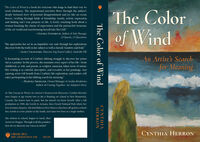
From: The Color of Wind, An Artist†s Search for Meaning. Cynthia Herron 2024 Luminare Press
 

The Color of Wind: An Artist's Search for Meaning

The Color of Wind: An Artist's Search for MeaningCynthia's memoir, revised edition published in June of 2024

View Book Images


Phone: 503-363-9040
e-mail: cynth.herron@gmail.com
 
Web design by designdance.com